

Low-Risk Testing Environment
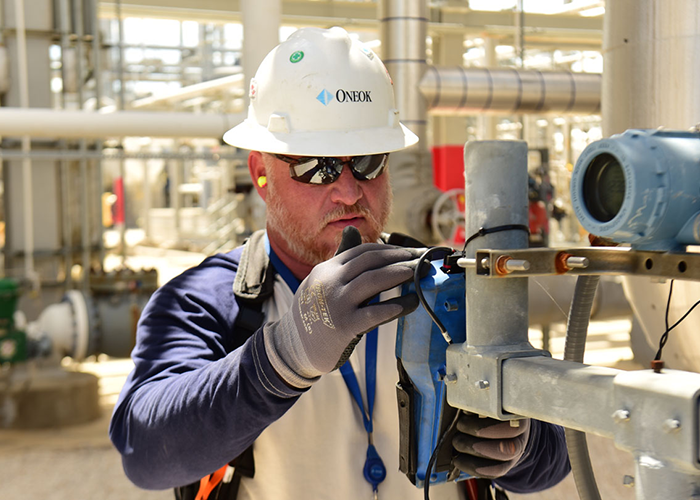
The Pipeline Control Simulator is a state-of-the-art project consisting of pipeline models simulating different operating conditions for Pipeline Control Center controllers.
Looking at his monitors, Jonathan East calmly identified a potential loss of pressure on the system – “maybe between Station 2 and Valve 104-001.”
“OK, got eyes on your pipeline,” Ryan Speier replied. “Don’t know about location but looks like you have a flow imbalance.”
“Looks like it’s between Stations 1 and 2,” said East, correcting himself.
“My diagnosis is agreeing with what you’re seeing,” Speier said.
At this moment, both Speier and East are confident they are seeing an unexplained pressure and flow loss on one of East’s simulated pipelines, indicating a pipeline leak. They are now going through next steps to respond to such an event.
East is a new employee being drilled on response, and Speier is conducting the drill.
“I’m going to notify my injections and deliveries,” East said as he began making simulated calls to his customers along the pipeline. “Going to have to shut down. We have some issues on our system right now.”
“Let us know when you can resume,” responded Speier, now simulating the response from customers called.
“They’re role-playing,” explained Innie Tobby, pipeline control simulation analyst in Tulsa, Oklahoma, perched behind the activity taking place. “Everything he’s executing is what he’d do if there was an actual emergency on the pipeline.”
East, operations controller – trainee, sat in the Pipeline Control Simulation room at ONEOK Plaza. Behind him was Speier, pipeline control simulation coordinator, also in Tulsa.
Tobby and Speier run the pipeline control simulator, a state-of-the-art project consisting of models simulating different operating conditions for Pipeline Control Center controllers.
“These trainings give our controllers the ability to learn and practice in a safe environment and the opportunity to become a consistent, reliable, optimized controller who understands pipeline hydraulics enough to sit down and successfully control the pipeline systems we operate,” said Jaret Pirtle, manager, gas control in Tulsa.
The scenarios provide controllers the opportunity to build desired muscle memory – not just in emergency-response situations but also when optimizing existing standard operations, like pipeline startups, shutdowns, shift change and schedule changes.
‘Great Opportunity for Standardization’
“The program simulates the look and feel of what you’d see in the Control Center during normal and emergency situations without the real consequences on actual assets,” Pirtle said.
“It’s building competence and confidence in a low-risk environment,” Speier said.
It’s also a great opportunity for standardization. “We have an opportunity to share and apply knowledge across the many pipeline systems we operate and to standardize our best practices,” said Pirtle.
The simulator trainings allow Pirtle’s team to test the fundamentals of each controller to gather data for future trainings.
“Once all controllers complete these standardized trainings, we plan to tailor future tiers to meet specific needs,” Pirtle said. “In concept, these sessions will be much shorter and designed to focus on simulation solutions.”
If a controller desires more practice on a particular pipeline startup because of complexity or the task being infrequent, “we would design the pipeline movement to focus on the various conditions and variables – planned or unplanned – that can potentially impact the decision-making for the controller,” said Pirtle.
The same concepts can be designed for other tasks, like third-party pipeline interruptions, optimization challenges, energy management or other requests impacting throughput.
“Each pipeline system is unique in the way it is operated and takes continuous time and effort to master and maintain proficiency,” Pirtle said.
‘Focusing on Brilliance in the Basics’
The simulator allows controllers to perform tasks repetitively in a low-risk environment. That helps improve performance when there are low risks. “From a supervisor feedback perspective, we’re getting synced up in the control room,” Speier said. “It’s attention to detail by focusing on brilliance in the basics, getting everyone unified.”
“One thing I gained from my visit to the simulator was how to read the SCADA screens and be able to start analyzing what is happening and how to address it,” shared Gabby Pinto Ordonez, PDP 1 in Tulsa. “The simulation program was really informative and thorough.”
Jose Ortega, supervisor, pipeline operations in Weatherford, Texas, saw the simulator this spring.
“They walked us through the critical steps of operating a pipeline from the Pipeline Control Center point of view,” Ortega said. “Our area pipeline reps really enjoyed the time and gained a different perspective on operating the system.”
In the real world, we have pipelines running in remote areas, Pirtle reminded. “We take steps to ensure these areas remain safe, and our simulation program is one of the ways we do that. That’s the beauty of what Ryan and Innie can do.
“For intentional training purposes, they can run a simulated pipeline up to its maximum design limits and beyond to explore/demonstrate a pipeline failure,” Pirtle continued. “What happens when you take the right actions in the response and what happens if you take the wrong actions – and you actually get to see that. You have that simulated luxury of low risks. You get it all figured out here in the simulation room.”
Years might go by in the real control room without seeing some of the scenarios or tasks that play out in the simulator, Speier said. “But, here, you get to practice so that when it actually does happen, you’re better prepared and you know the appropriate actions to take.”
At ONEOK (NYSE: OKE), we deliver energy products and services vital to an advancing world. We are a leading midstream operator that provides gathering, processing, fractionation, transportation, storage and marine export services. Through our approximately 60,000-mile pipeline network, we transport the natural gas, natural gas liquids (NGLs), refined products and crude oil that help meet domestic and international energy demand, contribute to energy security and provide safe, reliable and responsible energy solutions needed today and into the future. As one of the largest integrated energy infrastructure companies in North America, ONEOK is delivering energy that makes a difference in the lives of people in the U.S. and around the world.
ONEOK is an S&P 500 company headquartered in Tulsa, Oklahoma.
For information about ONEOK, visit www.oneok.com. For the latest news, visit the ONEOK newsroom or find us on LinkedIn, Facebook, X and Instagram.

Related Stories
VIEW ALL STORIES

Cross-Functional Engagement: Lab Teams Convene for Knowledge-Share Event
PROJECTS AND OPERATIONS
New Technology Helps Reduce Methane Emissions at Compressor Station